

National Technology Day Special: How AI-Powered Reverse Vending Machines Are Driving Goa’s Deposit Refund Scheme
~ AI-enabled reverse vending machines and QR-based verification technology will enable faster refunds, cleaner recycling, and fraud prevention under Goa’s upcoming DRS
~ National Technology Day 2026 focuses on ‘responsible, inclusive innovation’, a theme reflected in Goa’s technology-driven Deposit Refund Scheme
Panaji, May 2026 – As India marks National Technology Day on May 11, Goa’s upcoming Deposit Refund Scheme (DRS) is emerging as an example of how artificial intelligence (AI) and digital verification technology can strengthen waste recovery and recycling systems.
While National Technology Day is observed annually on May 11 to recognise India’s achievements in science and technology and the role innovation can play in solving everyday challenges, this year’s theme is ‘responsible, inclusive innovation’, focusing on technology that benefits all regions and communities, something that Goa DRS aspires to foster.
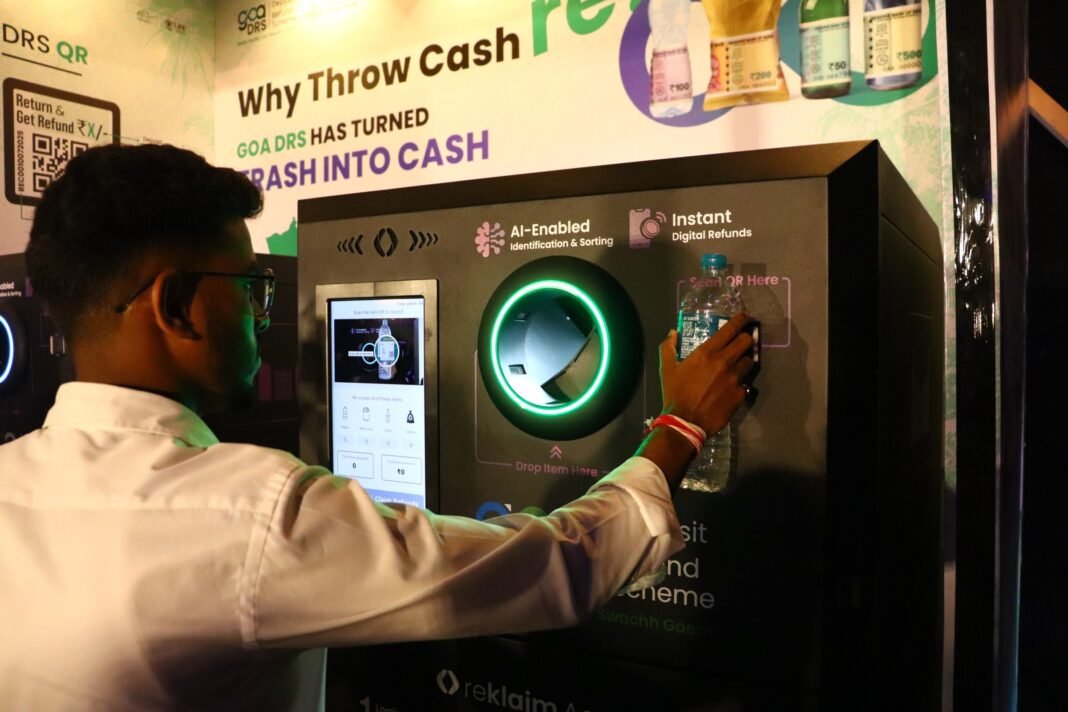
Under the scheme, public collection points will be set-up across the state with automated reverse vending machines (RVM) such as Reklaim Ace. These RVMs are equipped with imaging and AI engines which identify eligible packaging in seconds by scanning their QR codes, triggering instant refund of the deposit. The technology is designed to recognise any packaging accurately, reject incomplete or ineligible items and minimise breakage, particularly for glass bottles.
According to officials involved in the DRS rollout, the automated recognition technology reduces manual intervention, helping minimise errors and prevent duplicate refund claims. Each eligible container under the DRS will carry a unique serialised QR code linked to production records. Once scanned and refunded, the QR code is permanently deactivated, preventing duplicate claims and improving traceability across the recycling chain.
After interacting with the DRS Reverse Vending Machines at a recent outreach activity conducted at the Spirit of Goa festival, Haston Silva, Chief Technology Officer at Luarc said that this initiative “will make each person responsible for their own waste and ensure that it is not thrown away carelessly”.
The AI-enabled machines use visual recognition to identify containers under different conditions, including crumpled labels or partially damaged packaging, while helping identify and reject containers not registered under Goa’s DRS ecosystem. To ensure doorstep pickup handheld devices linked to the same system will be used for manual collection with the support of authorised attendants or collection partners. This will bring the same level of efficiency to doorsteps and neighborhood collection points as with the automated machines.
Naman Upadhyay, a Goa-based software engineer who interacted with the technology during a public demonstration, said he believed the AI systems would improve recycling efficiency. “I like the DRS initiative. The technology can make waste recycling more efficient and transparent. The QR-code technology will also help ensure instant refunds for people using the machines to dispose of plastic packaging,” he said.
Christian Rodrigues, a software developer who also experienced the system firsthand, said the technology could encourage more responsible disposal habits. “This initiative can encourage people to dispose of plastic waste more responsibly,” he said.
Both technology specialists had interacted with these AI-powered machines at an outreach event, one of the many conducted by the Goa DRS at popular cultural festivals like the Goa Cashew Fest and the Spirit of Goa festival, besides organising demonstration camps at Nadora, Assolna, Sal, Anjuna, Loliem Polem and Agonda panchayats in order to familiarise elected panchayat officials and local residents with the technology-driven waste management mechanism.
Designed for Indian consumption patterns and multilingual accessibility, the machines include audio-visual guidance systems aimed at making participation simple for residents, tourists, and local communities alike. Officials say the broader goal is to create a technology-enabled recycling ecosystem that is both inclusive and easy to adopt at scale.





 Loading ...