

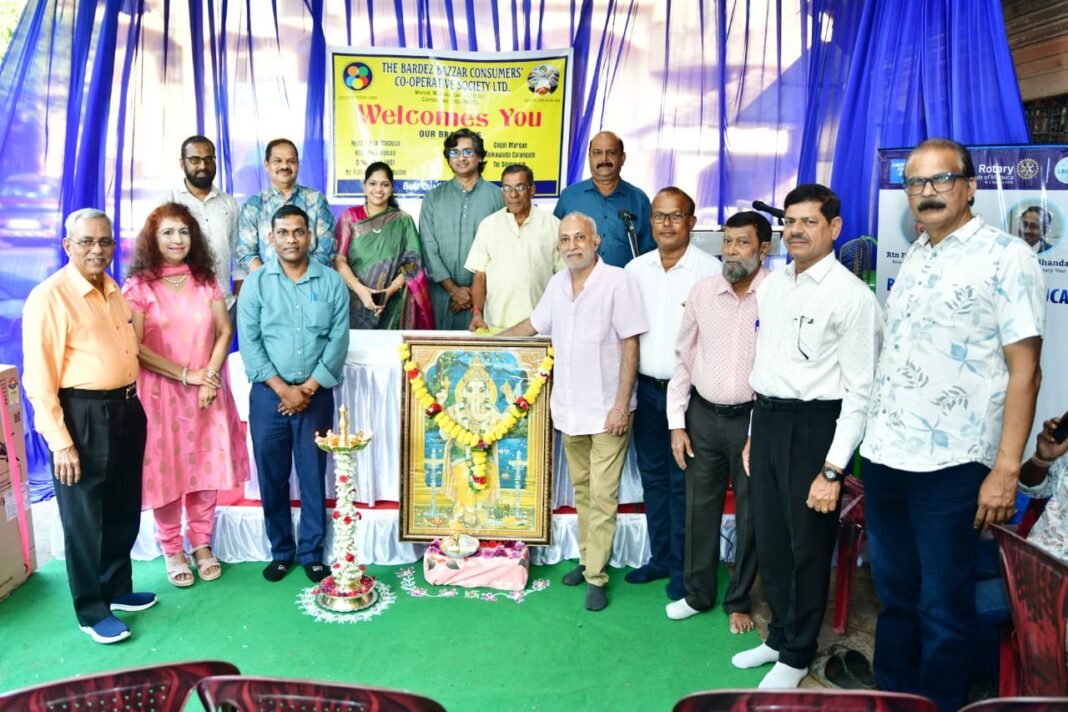
Cooperative movement essential for economic strength and job creation, says assistant registrar
Mapusa: The cooperative movement is of paramount importance today, playing a critical role in strengthening the economy and fostering employment generation, stated Rajesh Parwar, Assistant Registrar for Cooperative Societies.
Parwar was speaking as the chief guest at the 72nd All India Cooperative Week celebrations jointly organised by the Bardez Bazaar Consumers’ Cooperative Society (BBCCS) in association with the Rotary Club of Mapuca from November 12 to 20. The activities included a cooking competition, a prize distribution ceremony, the awarding of scholarships for students, and a small celebratory gathering.
Also in attendance were the guest of honour, Amita Salatry, Chairperson of the Consumer Protection Committee at the Goa Chamber of Commerce and Industry (GCCI), Nikhilchandra Khalap, Chairman of Bardez Bazaar, Eknath Nagvekar, Vice-Chairman of Bardez Bazaar, and Rohit Natekar, President of the Rotary Club of Mapuca.
Parwar reiterated the cooperative movement’s vital role in bolstering the economy and creating jobs. He emphasised that three aspects are crucial for the proper functioning of a cooperative society: management, staff, and, most importantly, shareholders who must demonstrate active participation. He added that management is legally obliged to conduct an annual general body meeting and present the audit report at this meeting, which reflects the organisation’s management.
To assist societies, the Central Government has introduced a new law creating the MPACS (Multipurpose Primary Agriculture Cooperative Society), an open platform allowing them to venture into other businesses, said Parwar.
He highlighted several schemes available, such as the common service centre, starting fuel stations, gas agencies, and grain storage, noting that NABARD provides monetary assistance for these ventures.
He also stressed that the cooperative movement’s success depends on supporting self-help groups, farmers (such as dairy and small farmers), and artisans (like those in handloom and handicraft), as both can mutually benefit.
Speaking on the significance of food, Salatry emphasised that “The presentation of the food is essential in competitions. The aroma must be good and taste as well. Use Goan elements leaves, etc for presentation.”
She said that India is unique in the world for referring to food as ‘annadevta’ (food is God). She highlighted the use of the term ‘annasaunstha’ and urged consumption in ‘annasaunskaran’, meaning no food wastage, eating only as per requirement, and no fighting while eating, as food is God.
“This is our country’s traditions and culture hence you should cook correctly,” she said.
Khalap stated that Bardez Bazaar will actively support self-help groups. He said that when any self-help group, housewife, new distributor, or businessman considers a distributorship, their first thought is of Bardez Bazaar and how working with cooperative organisations and selling to them will stabilise their business and establish their reputation in the market.
“Bardez Bazaar always supports such businessmen. I urge women self-help groups to take the first step, we will support you,” he said.
Khalap also recalled that former Prime Minister Pandit Jawaharlal Nehru had a vision for the cooperative movement to reach every house in the country. He said that the cooperative movement’s contribution is essential to becoming ‘atmanirbar’ (self-reliant).
He recounted that Nehru, at the start of India’s growth story after Independence, envisioned that where the government could not reach, the cooperative movement could reach every location, house, and village. Hence, Nehru described cooperatives as the ‘schools of democracy’, stating that if democracy is to be stronger, the cooperative movement must become strong.
“Nehru also described industries as the ‘modern temples of India’. This vision has been supported by all Prime Ministers, including the current Prime Minister Narendra Modi, who have given a lot of impetus to the cooperative movement,” Khalap added.
Khalap further saod that the Mapusa cooperative was established after its founder, Ramakant Khalap, and his companions were inspired by the sale of goods at a place called Varna Bazaar in Maharashtra. He said that Varna Bazaar sells all items, including hardware and sunglasses, and provides delivery in nearby villages.
“Inspired by this, Bhai Khalap and his companions sought to replicate the movement in Mapusa. They secured a Rs 5,000 loan from Mapusa Urban Bank as seed money, with no government support, and repaid it quickly. Today, Bardez Bazaar conducts Rs 35 crore in business without any loan or government support, standing on its own feet. It employs 100 people, supporting 100 families, alongside numerous distributors. He proudly shared that the cooperative has been continuously providing a 20% dividend to its shareholders for nearly 20 years, an amount that even a mutual fund would not yield,” he said.
Natekar announced that from next year, the Rotary Club of Mapuca, in collaboration with Bardez Bazaar, will establish a permanent project dedicated to assisting self-help groups and helping them advance. He also mentioned that the proposed mall by Bardez Bazaar would greatly benefit the people of Mapusa.
The cooking competition was organised by Bardez Bazaar in association with the Rotary Club of Mapuca, with Salatry acting as the judge. The theme was ‘Gomantakiya God Padarth’ – Goan sweet dish.
The winners were:
First prize: Mithila Harmalkar
Second prize: Antara Naik
Third prize: Harsha Redkar
First consolation prize: Ranjana Narvekar
Second consolation prize: Nafiza Shaikh
Third consolation prize: Varsha Polle




 Loading ...