

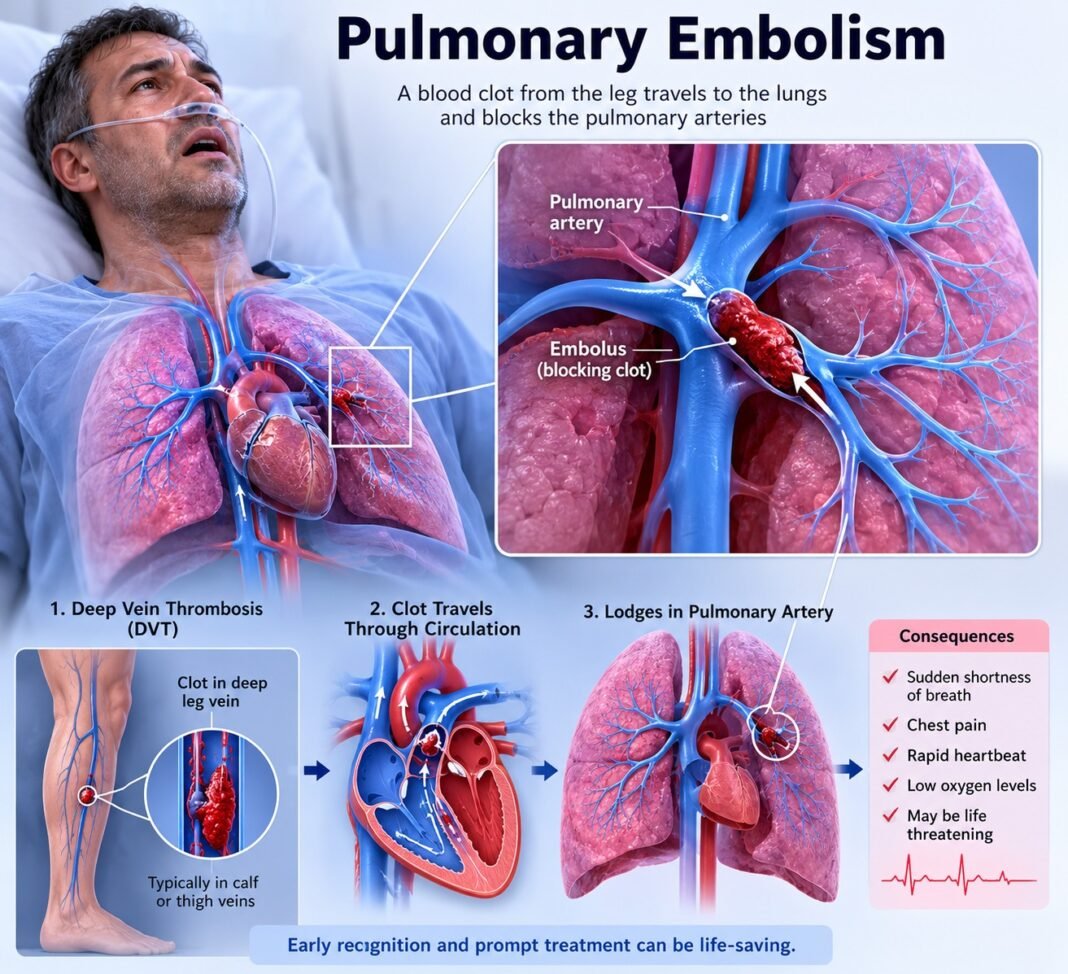
Pulmonary Embolism Can Strike Without Warning—Timely Treatment Saves 37-Year-Old:
PANAJI: A 37-year-old bank employee had recently moved to Goa to begin a new chapter of his life. Young, recently married and looking forward to the future, he never imagined that one evening he would be fighting for his life because of a condition many people have never even heard of.
He suddenly developed severe breathlessness and his blood pressure began to fall. Dr. Haradatt Kharande, Consultant Pulmonary Medicine at a hospital in Panjim suspected a pulmonary embolism—a life-threatening condition in which a blood clot blocks the arteries of the lungs. A specialized CT scan called CT pulmonary angiography confirmed the diagnosis. Recognising the urgency, he immediately referred the patient to Manipal Hospital Goa, where catheter-directed pulmonary thrombectomy was available.
By the time he arrived at Manipal Hospital around 11 pm on July 1, he was critically ill. The large clot had severely reduced blood flow to his lungs, placing tremendous strain on his heart. His blood pressure was dangerously low and he required medicines to support his circulation.
Emergency Physician Dr Neerja promptly shifted him to the Medical Intensive Care Unit, where the Pulmonary Embolism Response Team (PERT) was activated. The on-call multidisciplinary PERT team – Dr John Muchahary (Pulmonary Medicine), Dr Charudutt Jayant Sambhaji (Endovascular Surgery & Interventional Radiology), Dr Elaine Rodrigues (Critical Care), and Dr Yogesh Gaude (Anaesthesia) – promptly responded.
After rapidly assessing the patient, the team concluded that waiting for clot-dissolving medicines carried a high risk because his condition was deteriorating quickly. They therefore proceeded with emergency catheter-directed pulmonary thrombectomy.
Leading the procedure was Dr Charudutt Jayant Sambhaji. Explaining pulmonary embolism in simple words, Dr Charudutt said, “It is like the heart is a pump and the blood vessels are pipes. The pump is working, but the pipe is blocked somewhere. The heart keeps pushing harder, but the blood cannot reach the lungs properly to collect oxygen. That puts tremendous pressure on the heart and can become life-threatening within a very short time.”
Around 1 am on July 2, the patient was taken to the Angiography Suite called Cath Lab. Instead of performing open surgery, Dr Charudutt inserted a thin catheter through a blood vessel and carefully guided it into the arteries of the lungs. Using a specialised suction-based device, the medical team removed the clot that had blocked the blood flow.
The procedure took only a short time, but the results were immediate. Before the clot was removed, the pressure inside the patient’s blood vessel supplying the lung measured 28 mmHg, indicating severe strain on the heart. Once the clot was extracted, the pressure dropped dramatically to 8 mmHg, which is within the normal range. His heart rate returned to normal while he was still on the procedure table.
The doctors even asked him how he was feeling. “He immediately said he was feeling better,” recalled Dr Charudutt. For the medical team, it was a deeply satisfying moment. The greatest challenge was not the procedure itself but recognising the emergency and acting without delay, he added.
He explained, “Massive pulmonary embolism is a race against time. If we simply wait for medicines to dissolve the clot, the heart may fail before the medicine gets a chance to work. By removing the clot directly, we restore blood flow immediately and reduce the pressure on the heart.”
The doctor also noted that pulmonary embolism deserves the same urgency as a heart attack or stroke. “Most people know about heart attacks and strokes, but pulmonary embolism is another major medical emergency. All three need immediate treatment because delaying care can cost a life,” he said.
The patient was fortunate for another reason. Although his clot in the lungs was large, he reached the hospital before suffering cardiac arrest. “He was young, which gave us a small window of opportunity,” Dr Charudutt explained. “If patients reach us after they have already suffered a cardiac arrest, saving them becomes much more difficult.”
Over the next few days, the patient’s recovery continued steadily. His breathing improved, his heart function returned to normal and follow-up tests showed that the pressure on his heart had completely normalised. Just a week later, he returned to the hospital for a review, doing well and recovering normally.
Dr Charudutt believes awareness is one of the biggest weapons against pulmonary embolism. He advises people not to ignore sudden breathlessness, chest discomfort, fainting episodes or swelling in leg, as these could be warning signs of a blood clot. Anyone experiencing these symptoms should seek medical attention immediately as early diagnosis and timely treatment can save lives. Long hours of sitting, dehydration, prolonged travel and certain illnesses such as cancer can increase the risk of developing clots.
“This successful outcome was the result of teamwork. Every doctor—from the initial diagnosis to completion of the procedure—played a vital role in saving this patient’s life,” added Dr Charudutt.





 Loading ...