

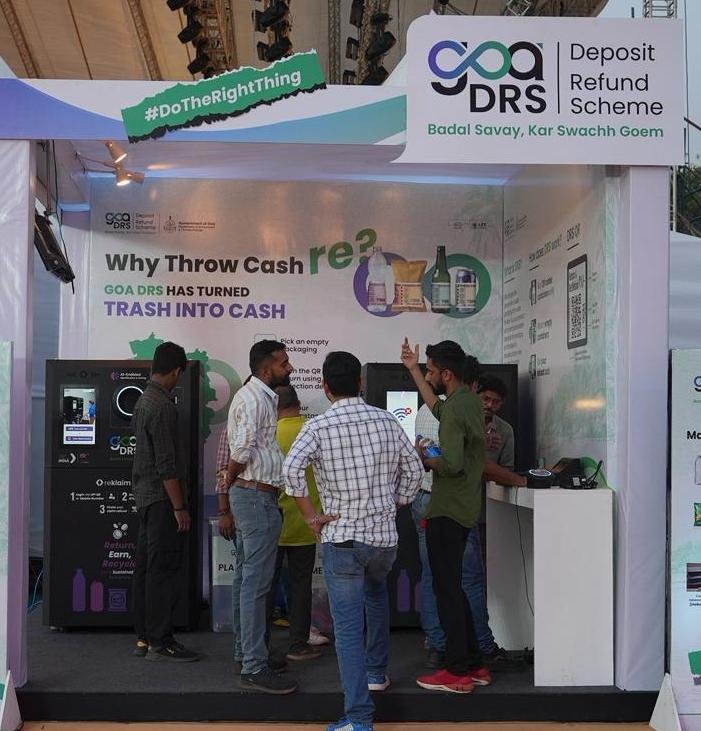
DRS Smart Collection Systems Demonstrated at Goa Cashew Fest Season 4
~ A suite of Indian-made smart collection machines from high-volume RVMs to handheld devices enables seamless and scalable packaging recovery across Goa.
Panaji, April 2026: The Goa Cashew Fest Season 4, known for celebrating the state’s iconic produce, is also spotlighting sustainability this year with a live demonstration of smart waste collection technologies under the Goa Deposit Refund System.
Aligned with the festival’s focus on innovation and responsible practices, the Department of Environment & Climate Change, Government of Goa, is advancing DRS as a behavioural change initiative aimed at reducing litter, improving recycling outcomes and strengthening waste recovery systems across the state. By attaching value to packaging, the system encourages consumers to return non-biodegradable packaging including glass bottle, PET, aluminium cans and multi-layered packaging through a network of collection centres, partner return points, reverse vending machines (RVMs) and door-to-door collection systems.
Upgraded by QR-code traceability, DRS ensures transparency and accountability across the waste recovery chain by capturing data that would otherwise be missing, misreported, or lost entirely in conventional waste management systems. This prevents fraud and facilitates recovery of clean, recyclable materials. The system also formally integrates informal waste workers, creating more stable and improved income opportunities.
At the festival, a dedicated demonstration zone offers visitors a first-hand experience of how these technologies function in real-world settings. Building on its growing public outreach with demonstrations conducted across several events in Goa, this experience zone invites citizens, stakeholders and tourists to engage directly with the system and understand how it can seamlessly integrate into everyday consumption habits.
At the centre of the demonstration are high-volume Reverse Vending Machines engineered for efficient, scalable recovery in public environments. These devices are built to handle multiple packaging formats across varying footfall conditions, highlighting how different form factors can support deployment across Goa’s diverse landscape. Equipped with advanced AI and imaging technologies for accurate material identification, the systems also feature multilingual audio-visual prompts and high-speed QR-based processing to enable seamless returns. Offering reliability, these devices incorporate soft-landing mechanisms to minimise breakage, large storage capacities for continuous operations, and integrated digital payment systems for instant refund processing.
The Reklaim Ace is a high-speed unit engineered for rapid throughput and enhanced user interaction. It can identify items in under 20 milliseconds, supports containers up to two litres, and features a 16-inch multilingual display along with a QR scanner capable of processing up to 70 scans per minute. Its 900-litre capacity makes it ideal for high-footfall public locations.
Supporting these high-volume machines is the Reklaim Fastscan, which focuses on speed and convenience. Equipped with an interactive LED interface, a 7.9-inch display and integrated UPI-based payment systems, it can process up to 45 QR codes per minute, enabling quick and seamless transactions.
For flexible deployment, the Reklaim Mini offers a compact solution for smaller or temporary locations. It includes multilingual prompts, a fast QR scanner and up to 48 hours of battery backup, ensuring uninterrupted performance across varied environments.
Equipped to support last mile doorstep collections, Reklaim Go is a lightweight, portable handheld device with in-built scanner, speaker and display for audio and visual information communication.
All machines showcased are made in India and designed to suit local consumption patterns, leveraging the country’s growing AI capabilities.
The deployment of these technologies is part of a broader effort under DRS to build a scalable, technology-driven recycling ecosystem in Goa. By making returns convenient and rewarding, the system aims to reduce litter, improve material recovery and move the state closer to a circular economy model.





 Loading ...