

Actor Rukmini Vasanth Joins Hands with PETA India and CUPA to Gift Life-Size Mechanical Elephant, Mahanandi, to Karnataka’s Shree Ujjaini Peetha

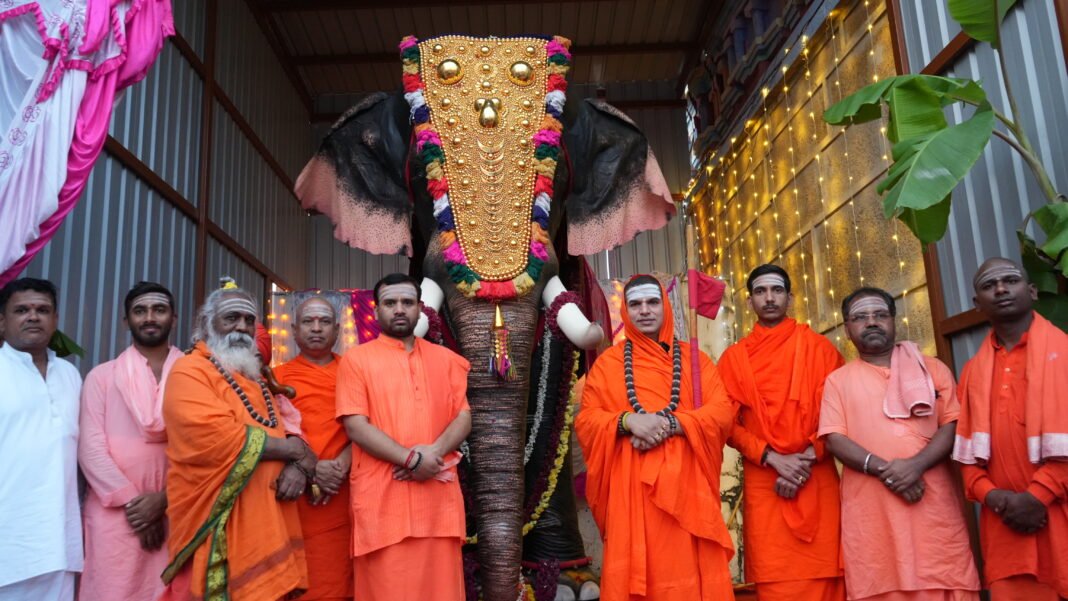
Vijayanagara – Renowned actor and SIIMA Award winner Rukmini Vasanth, People for the Ethical Treatment of Animals India (PETA India) and Compassionate Unlimited Plus Action (CUPA) have donated a life-size mechanical elephant, Mahanandi, to Karnataka’s Srimad Ujjaini Jagadguru Saddharma Simhasana Mahasamsthana Peetha, also known as Ujjaini Peetha, at Kottur in recognition of the temple’s decision to never own or hire live elephants.
Member of Parliament Bellary, Sri E Tukaram; Member of the Legislative Assembly (MLA) Shikaripura, Sri B Y Vijendra; MLA Ron, Sri Gurupadagouda Patil; MLA Kudligi, Dr NT Srinivas; MLA Gangavathi, Sri G Janardhan Reddy; MLA Bilgi, Sri JT Patil; Sri Sri Sri 1008 Jagadguru Veerasimhasana Dr. Prasannarenuka Veera someshwara Rajdeshikendra Shivacharya Bhagwatpada Mahaswamiji, Sri Sri Sri 1008 Jagadguru Siddhalinga Rajadeshikendra Shivacharya Bhagavatpada Mahaswamiji along with other dignitaries and Matha devotees, attended the unveiling ceremony of Mahanandi, which will be used to conduct ceremonies at the Matha safely and cruelty-free, helping real elephants stay with their families in the jungle. The inauguration ceremony was followed by a procession.
“I feel immense joy to present Mahanandi to the revered Ujjaini Peetha with PETA India and CUPA. Mechanical elephant Mahanandi exists to allow devotion to be expressed with respect for peace in animals’ lives,” said Rukmini Vansanth. “I envision a future in which elephants roam freely with their families in forests and where rituals, ceremonies, and festivals are conducted safely, without the risk of elephant attack.”
Celebrating the visionary initiative by PETA India and CUPA to equip temples in Karnataka with mechanical elephants, the Chief Swamiji of Ujjaini Peetha, Sri Sri Sri 1008 Jagadguru Siddhalinga Rajadeshikendra Shivacharya Bhagavatpada Mahaswamiji, said “We are overjoyed to welcome Mahanandi, our temple’s new mechanical elephant, who allows us to carry forward our sacred rituals in a way that is not only safe for devotees but also rooted in kindness. This step marks a beautiful union of devotion and compassion, where no animal suffers for our worship.” Swamiji added, “I sincerely encourage other temples to walk this path of compassion and tradition by adopting mechanical elephants.”
MLA Shikaripura, Sri B Y Vijendra said, “I am very happy to welcome Mahanandi at the revered Ujjaini Peetha. It is a landmark moment that beautifully blends devotion with compassion. I congratulate the Peetha, PETA India, and CUPA for leading by example and showing the nation that our rituals can remain timeless with such beautiful mechanical elephant.”
MLA Ron, Sri Gurupadagouda Patil said, “This mechanical elephant is a very good example of how technological innovation enables us to preserve our deep cultural traditions and heritage. I am happy that Ujjaini Peetha will use this mechanical elephant which will ensure that devotees can participate in festivals in a safe environment. It is a very good way to promote kindness to our children. I congratulate PETA India and CUPA for this initiative.”
“We at PETA India are deeply moved and grateful for the overwhelming response to the mechanical elephants we’ve gifted. Each one embraced by temples is a symbol of kindness and respect for animals,” said PETA India’s Vice President of Celebrity and Public Relations Sachin Bangera. “As more and more temples come forward with open hearts to welcome these lifelike elephants, together we are creating a future where no real elephant endures chains and suffering.”
Elephants are intelligent, active, and gregarious wild animals. In captivity, they are trained to be used in processions through beatings, the use of weapons, and force. Most elephants held captive in temples and other places suffer from excruciating foot problems and leg wounds due to being chained to concrete for hours on end. Most are denied adequate food, water, veterinary care, and any semblance of a natural life. Under these hellish conditions, many elephants become intensely frustrated and lash out, sometimes killing mahouts or other humans or animals.
According to figures compiled by the Heritage Animal Task Force, captive elephants killed 526 people in Kerala alone in a 15-year period. Thechikkottukavu Ramachandran, who has been in captivity for about 40 years and is one of the most often used elephants in Kerala’s festival circuit, has reportedly killed 13 individuals – six mahouts, four women, and three elephants. In 2025, at least twenty captive elephants in Kerala had become upset and killed six people on different occasions, injuring several others, or damaged property
PETA India ignited the sympathetic movement to replace the use of live elephants by religious institutions at the beginning of 2023. Now, at least twenty mechanical elephants are used in temples across India. This new mechanical elephant, Mahanandi, is a landmark seventeenth robot donated to temples in South India by PETA India. Out of those, PETA India has donated seven mechanical elephants in Karnataka, of which six were in collaboration with CUPA, including the Muzrai Department-governed Yediyur Sri Siddalingeshwara Swamy Temple.
Mechanical elephants are 3 meters tall and weigh 800 kilograms. They are made with rubber, fibre, metal, mesh, foam, and steel and run on five motors. A mechanical elephant looks, feels, and can be used like a real elephant. It can shake its head, move its ears and eyes, swish its tail, lift its trunk, and even spray water. They can be climbed upon, and a seat can be affixed on the back. They can be operated simply by plugging and playing with electricity. They can be taken through the streets and are mounted on a wheelbase, allowing them to be moved and pushed around for rituals and processions.
Ujjaini Peetha is one of the Panchapeethas, alongside Baalehonnur, Kashi, Kedar, and Srishaila, and has a vast complex including the temple of Sri Marulasad and the grand math. It also has memorial buildings like Gouramma, Bangarada Basavanna, Nandi temples, and Sri Siddhalinga Jagadguru Samadhi. Ujjaini Peetha is the abode of the revered Jagadguru and is a cultural center, and has Jagadguru Shiv Puja Mandir, their dormitory, Daruka Mandir, Goshale Panchacharya, and Sabhabhavan. The artistic splendor here is unique in the history of the Vastu Shilpa art of Karnataka.
PETA India – whose motto reads, in part, that “animals are not ours to use for entertainment or abuse in any other way” – opposes speciesism, a human-supremacist worldview. For more information, please visit PETAIndia.com or follow the group on X, Facebook, or Instagram.





 Loading ...