

Congress to appoint district presidents based on merit and loyalty: Singla
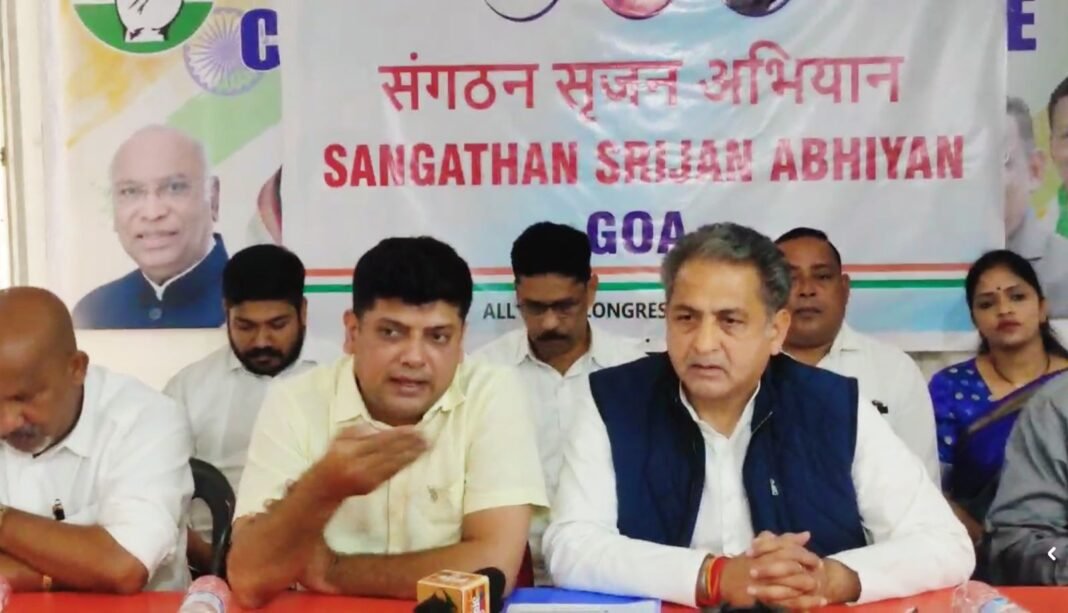
MARGAO: The Congress party is set to appoint new district committee presidents by evaluating a range of critical factors, including caste representation, past performance, and party loyalty. The announcement was made by Vijay Inder Singla, All India Congress Committee (AICC) Observer and Joint Treasurer, during a press conference held at the South Goa District Congress Office in Margao on Thursday. The briefing was part of the party’s Sangathan Srijan Abhiyan initiative.
Amit Patkar, President, Goa Pradesh Congress Committee (GPCC), M. K. Shaikh, Senior Vice-President, GPCC, Altone D’Costa, Quepem MLA, Archit Naik, Goa Youth Congress President, Savio D’Silva, former South Goa Congress President, Pratiksha Khalap, Mahila Congress President
Amarnath Panjikar, Chairman of the Congress Social Media Cell, among others were in attendance.
GPCC President Amit Patkar said that the state party has established a new district, Kushavati, as part of its organisational restructuring. The new district comprises eight assembly constituencies.
Singla has been appointed as the observer for Kushavati and will be assisted by a team including South Goa Member of Parliament Captain Viriato Fernandes, Panjikar, and Khalap.
“This team of four persons will visit all eight constituencies and meet senior leaders and party workers,” Patkar stated. He added that once a district president is elected, the team will prepare a comprehensive report and share further information.
Singla said that The Indian National Congress has launched the Sangathan Srijan Abhiyan— a nationwide organisational transformation campaign—following the recent AICC session in Ahmedabad.
“This initiative is about building a stronger, more accountable, and people connected party structure starting from the District Congress
Committees,” he said.
Singla, a former Punjab PWD Minister and ex-MP, said he would spend the next two days visiting party workers across all eight constituencies in Kushavati. He said that four AICC observers have been assigned to individual districts in Goa to identify new talent, build the organisation, and ensure various castes are represented in DCC leadership roles.
“There will be a lot of powers given to the new DCC presidents. This will come with accountability, and they will be monitored for three months. Those not doing well will be replaced. It is not like earlier times when DCC presidents were appointed and continued for years without working,” Singla said.
The primary objective of the Abhiyan is to fortify the party at the grassroot level, said Singla, and detailed plans to revamp political affairs committees and executive committees at the district level to encourage broader participation.
“Every district has different issues involved. Earlier, issues were being raised at the state level against the government, but now, once the political affairs committee at the district level is formed, issues pertaining to the district can be discussed among the party cadres and raised at both the district and state levels,” Singla said.
Addressing the decision to divide the former South Goa district, Singla said that managing 20 constituencies had become too difficult for a single DCC president.
On the recommendation of state leadership, the area has been split into two districts: Kushavati and South, he said.
Singla said there will be a rigorous screening method for the selection process of DCC president.
“I will be visiting all eight segments in Kushavati in the next two days, meeting all office bearers, social organisations, cadres, and workers, so that more hardworking, loyal people without criminal backgrounds are given responsibilities at mandal, booth, panchayat, block, and district levels,” he said.
Singla will conduct one-on-one interactions to gather viewpoints on potential candidates. The party intends to propose six names to the central leadership based on caste dominance and representation, loyalty to the party, past experience and service and active involvement in party programmes.
In a move toward transparency, application forms have been circulated via social media. Singla encouraged aspirants from all backgrounds, including SC/ST and OBC communities, to apply.
“I want to convey to all the aspirants who want to become a part of the process that they can fill up the form and meet me or email it to me, and I will get back to them,” he said, adding that the party would also interact with members of civil society during the process.





 Loading ...